
Former Lioness Anita Asante says elite teams fail when they forget the person behind the performance
‘It always comes back to how you recover from setbacks’
Former first-team coach of Bristol City FC and the former England international and Olympian discusses resilience, visibility and why high-performance cultures must put the human first.
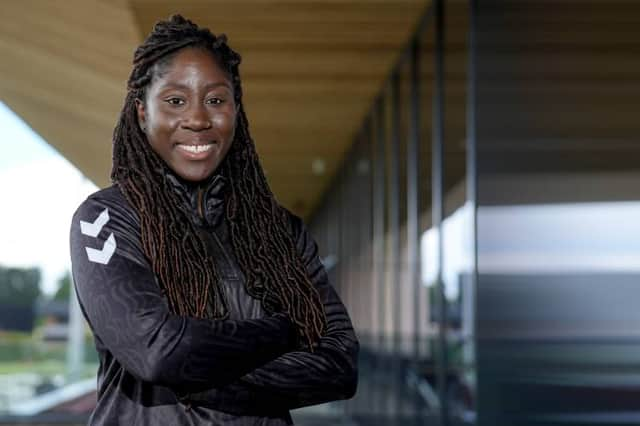

Anita Asante has spent her career proving that pressure does not only test talent. It tests character, adaptability and the people around you.
A former professional footballer for Arsenal, Chelsea, Aston Villa and England, Anita earned 71 international caps, represented Team GB at the London 2012 Olympics and later became first-team coach at Bristol City FC. She is now a BBC pundit and one of the most respected voices in women’s football.
As a diversity and inclusion speaker, Anita brings rare authority to conversations about leadership, equality, teamwork and visibility. She has spoken openly about gender, racial and LGBT+ equality in sport, and is an ambassador for Show Racism the Red Card and Amnesty International UK.
In this exclusive interview with the High Performance Speakers Agency, Anita discusses adapting across clubs and countries, recovering from serious injury, stepping into media and public speaking, and why high-performance environments get better results when they see the human first.
Question 1. Your career has taken you across different countries, clubs, coaching styles and serious injuries. What did that teach you about adaptation, resilience and putting the team first?
Anita Asante: “I had to adapt multiple times, not just playing in different countries, but different clubs as well, because the coaches I played for and the teams had different playing DNA and playing philosophies.
“Sometimes, that required me to do different things. Examples of that would be whether I played a more possession-orientated type of game or whether I had to play slightly more direct.
“As a player, you have a natural bias towards the things you like to do and enjoy. But I had to shift my mindset and recognise that playing the way the coach or the team would benefit most helps all of us collectively, either to get the result or follow through with a game plan.
“A key part of that is mostly psychological rather than technical. It is being able to shift your mindset and framework, take the “I” and the ego out of it, and think more about the collective.
“I have had a few different injuries. As a footballer over the years, I have had lots of highs and lows.
“I have had two ACLs, which takes you out for nine months to a year of a season. That is a lot of football to miss.
“For me, it was always about having a close social network. Often, that was my teammates, who are my friends and who I refer to as family, because I spend the most time with them daily on the training pitch.
“My family is also my sounding board. They are the ones I can probably be the most vulnerable with.”
Question 2. How have setbacks shaped the way you think about performance, leadership and the need to keep moving forward?
Anita Asante: “It always comes back to how you recover from setbacks.
“How quickly I was able to bounce back, and actually to be able to look at it as a way to bounce forward. Not to sit in the past, but to look at even the worst-case scenario and ask what positives I could take from it.
“Often, it was learning about myself in those moments, that kind of silent reflection. It was finding another level of discipline to commit to recovery, a loss or anything like that.
“Ultimately, it always comes back to what matters most. Why do I do what I do? Why do I want to get myself back to where I have been, or how I have felt when I was at my highest and felt my best?
“That is the emotion I think all of us chase: feeling good about the things we have done and, maybe at times, wanting that validation.
“That is no different for me. I always go back to: I am doing this because I want to get there. That is my purpose.
“That clear focus, level of clarity and transparency is what I have relied upon, because you work with experts all the time who tell you to do this in the gym or do that on the pitch. I am trusting their knowledge, but I have also got to challenge it and ask why. How is it going to help me improve?
“That is part of creating your own direction and improving as a player.
“The most important thing when it comes to setbacks, failure, or what we might see as failure as athletes on the pitch, is learning to train behaviour and your reaction to it.
“When things go wrong on the pitch, whether it is a pass, a misplaced tackle or a missed shot, it is easy to show negative body language. It is also easy to go to the worst part of our emotion and feeling, rather than flip it and ask: what is the next positive thing I can do to counter the thing I did not execute so well?
“The next thing is to focus on the next immediate action. That could be making sure I am connected with my unit again because the picture in the game has changed and I need to be aware of the dangers of a forward, or it could be receiving the next pass.
“My pure focus is on that action and executing it. The last thing has gone. I can still make this a really good action by focusing on it.
“That shows how quickly things can change. It shows how quickly we can go from failure to success. It is all determined by what you deem as success.
“I am going to make mistakes in a game because that is the nature of the sport. Success for me is how often I react with positive behaviour that probably will lead to me executing something well.”
Question 3. Since moving into media, commentary and public speaking, how have you handled new environments where you are still learning in real time?
Anita Asante: “It is about how people react and training behaviour. That is something we can all train: how we move on to the next task positively.
“The way I have approached it is by putting myself in what you might term the deep end. I put myself in situations that are unfamiliar, or that have felt daunting because of my lack of experience before transitioning into them.
“I relate it to playing a game of football. Every game is different and every scenario within that game is different. There are different possibilities, outcomes and challenges I will face in a football match.
“Transitioning into things is quite similar. You do not know what to expect until you are in it. Once you are in it, you are constantly learning. If you are constantly curious, you are asking questions about the environment you are in and how you can be better.
“That has been my approach, especially to media and becoming a pundit and commentator. I am working with a main commentator, so how can I support them? Equally, how can they support me to be at my best? We are a team, whether we are a duo or working with a bigger presentation group.
“In terms of speaking, I look at it as an adrenaline rush, but also a nerve-wracking experience. When you speak to a live audience, you are front and centre, with all eyes on you.
“You want to make sure people leave the room feeling inspired, and that they can take away solutions or things that will help them in their own lives or workplaces.
“That is my motivation, but it is also the very human side of me. I experience those things. Having been an athlete, that adrenaline, rush and nerves are part of being an athlete as well. I am familiar with those feelings, so I find ways to harness them in each transition.”
This exclusive interview with Anita Asante was conducted by Tabish Ali of the Motivational Speakers Agency.