
Severe safety risk could see footpath near Bristol blocked – but the alternative is notoriously dangerous

A footpath in the countryside north of Bristol could soon be blocked off to the public because of a severe safety risk.
The public right of way runs over a railway north of Charfield in South Gloucestershire but Network Rail fears that the footpath is too dangerous to remain open.
The footpath runs from Poolfield Farm Lane over the railway, which runs along an embankment, to New Street. Steps carry walkers to the top of the embankment, where they must then cross the tracks that carry trains running from Bristol to Gloucester, Cheltenham and further north.
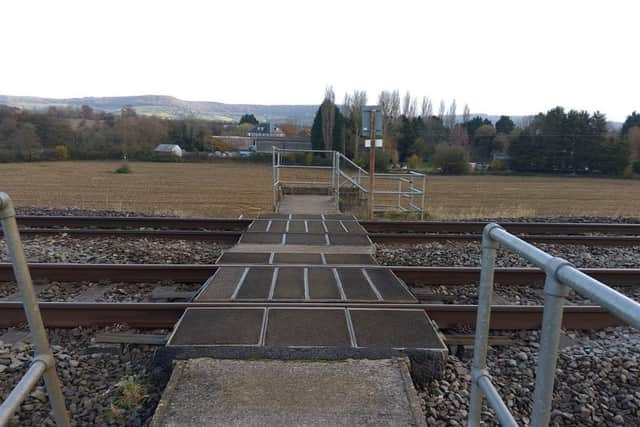

Network Rail is applying to South Gloucestershire Council to “extinguish” the footpath over the railway. Councillors on the public rights of way and commons committee will vote on Wednesday, December 10, whether to approve the plans and allow the path to be blocked.
A committee report said: “There is no active method of warning at the crossing, users are expected to form their own decision on whether it is safe to cross or not by stopping, looking and listening for approaching trains. It is also an unprotected crossing so train services can traverse the crossing whether it is occupied or not.
“A pedestrian may think they have longer to cross than they actually have. They may commit to crossing when seeing a train approaching believing the train is travelling at a much slower speed and mistakenly think they have plenty of time to clear the path of the train. A person’s judgement of speed is intuitive and often based on the daily experience of road vehicles.
“This can give rise to a highly inaccurate perception of the speed of an approaching train. Network Rail has driver reports and video footage of misuse and near misses, mostly children, and keeps a record of these. Use of the crossing ranges from 19 to 28 people a day, mostly dog walkers using it as a circular walk.”
Councillors could refer the issue to the government, asking them to order Network Rail to build a bridge or tunnel. That way people could still use the footpath, but without the risk of crossing the tracks. But Network Rail said this would be too expensive for them to construct, potentially around £3.5 million.
Around 157 trains pass over the crossing every day. 55 of these are high-speed passenger services, 66 are local commuter services, 27 are freight trains and nine are empty coach trains. Network Rail says the lack of visibility is partly due to the track curving around a bend.
Local residents are objecting to the proposed closure of the railway crossing. The alternative route would mean using a zebra crossing in the village, which is “notoriously” dangerous. Their responses to a public consultation were included in the report to the committee.
One resident said: “As a dog walker, the fields that surround Charfield are ideal. I have had no issues crossing the railway bridge, but a shockingly high number of near misses on that zebra crossing. The zebra crossing, soon to be our only realistic route to New Street, is significantly more dangerous than the railway crossing.”
Another resident added: “It would be a real shame to lose this connection from one side of the village to the other. The crossing is currently well used and with the large housing developments that will soon be built in Charfield, this access would be even more useful to residents.”
The row over the railway crossing has trundled on for almost two decades, highlighting the bizarre, bureaucratic and arcane law over public rights of way — involving barristers, two government departments and a regulator, all for a few hundred metres of a countryside path. A councillor first raised safety concerns in 2006, due to fast trains and a lack of visibility.
Over the next few years, Network Rail carried out improvements. This included clearing vegetation to make spotting trains easier for pedestrians. But they also proposed to increase how fast trains ran along the railway, and the level of hazard was still believed to be too high. In 2011, Network Rail applied to the council to divert the footpath.
The following year, the public rights of way committee considered the application, then referred it to the Department for Environment, Food and Rural Affairs in 2013. A barrister, known as an inspector, agreed that the crossing was unsafe in 2014 but thought Network Rail should give more consideration to building a tunnel. She referred the issue to the Department for Transport.
Because so much time had passed, the DfT said in July 2014 that no decision could be made about ordering Network Rail to build a bridge or a tunnel, as a statutory deadline had expired. Then the Office of Rail Regulator also got involved, and Network Rail applied to the council again in 2016. This went back and forth between an inspector and government departments.
As hundreds of homes are due to be built in Charfield, the number of crossings is expected to grow, increasing the risk and adding to pressure. Even if councillors once again decide the crossing should be blocked off, the back and forth between different parts of bureaucracy could soon be repeated — and the proposed closure could again hit the buffers.