
Money I have tirelessly earned is being used to fund weapons that kill my brothers’ and sisters’ children
The Avon Pension Fund may not have enough support from its members to end its investments in arms companies — as a vote on the controversial issue approaches.
The Avon Pension Fund Committee is due to meet next week to make a decision on whether the £6bn fund, which administers the Local Government Pension Scheme across the former county of Avon, should divest from the aerospace and defence sector. Over the last year, public sector workers in the Bath and Bristol area have campaigned for the fund to stop investing in weapons over concerns that their pensions are being used to fund human rights abuses by Israeli forces.
But there may not be enough support across the fund’s 100,000 members to make the decision. A survey of the fund’s members carried out in September found that 42% supported divesting, while 47% wanted the fund to continue to invest in aerospace and defence.
Bristol Palestine Solidarity Campaign has said that 47% in support is “no clear mandate to continue to fund the war industry.” But lawyers have said that the fund would need to have a “broad consensus” of members in support before it made a decision with a financial impact for non-financial reasons.
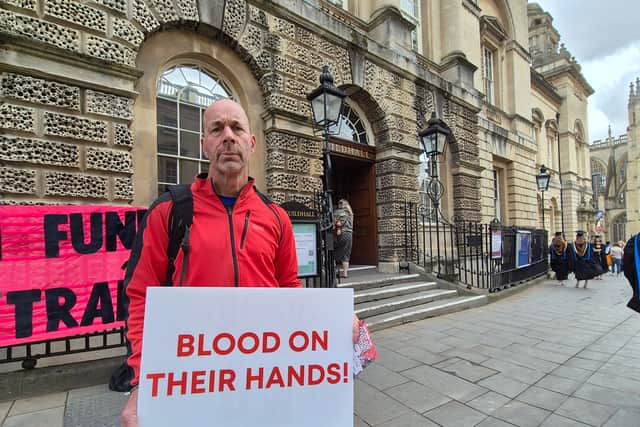

The point was raised at a meeting of the fund’s Local Pension Board on December 3, an advisory body that monitors the committee’s decisions. Toby Simon, the Bath and North East Somerset councillor who chairs the Avon Pension Fund Committee, told the board meeting: “It’s clear that there is a significant body of opinion that believes we should divest but it’s not a majority. […] But we have to take account of the very strong minority view, which is stronger for people of working age.”
Bristol City Council and North Somerset Council — staff at both of which are members of the fund — have passed motions urging the pension fund to divest from weapons companies making weapons used by Israel in Gaza.
Addressing a meeting of the fund’s committee in March, children’s social worker Toni Mayo said: “The money that I have earned by trying tirelessly, at grave personal cost, to keep children safe is being used to fund the weapons that kill my brothers’ and sisters’ children abroad. For every day I work, I’m unwillingly contributing to genocide and war.”
The Avon Pension Fund has approximately £18m (0.3% of its assets) invested in 20 companies in the aerospace and defence sector. The fund said the companies made “nearly all” their sales to the UK, NATO, and Ukraine but that some also supplied Israel.
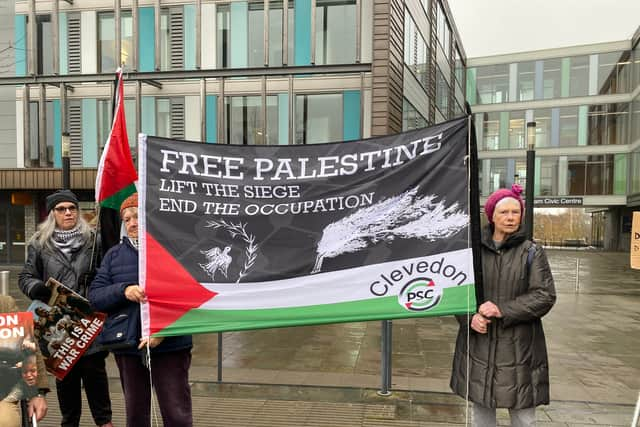
Rather than having directly purchased shares in arms companies, the Avon Pension Fund’s investments are part of a passive equity pool, a financial product splitting money across thousands of companies, called the Brunel Fund, which was chosen because it is aligned with the 2015 Paris agreement on reducing greenhouse gas emissions.
The financial cost of divesting from the aerospace and defence sector — estimated to be about £1m a year — is not from losing the sector’s profits, but because the Avon Pension Fund would need to set up a separate pool excluding the sector, which could cost that much a year for the fund to administer on its own. This cost could be brought down if other pension funds also decided to divest from the sector and joined the pool.
The Avon Pension Fund already excludes businesses making controversial weapons such as cluster munitions and chemical weapons, or those which breach a UN principle on businesses making sure they are not complicit in human rights abuses. Lockheed Martin and RTX are already excluded from the fund’s portfolios on these grounds.

The survey found that women and the under 55s were more likely to favour divesting from the aerospace and defence sector, while men and people over 55 were more likely to support continuing to invest. The survey’s responses were then precision weighted according to the demographics of the fund’s membership. 71% of the Avon Pension Fund’s members are women but more men responded to the survey than women.
20,000 randomly selected members of the fund were contacted by email to take part in the survey, with a response rate of 9.5% — which is double the expected response rate for similar surveys. The survey was designed to produce a “statistically robust sample” even with a lower response rate.
The Avon Pension Fund Committee will make its decision on divesting from the aerospace and defence sector at its meeting at 10am on December 12 in Bath Guildhall.